Scores Are Manufactured by Scoring Rules
A model's score is never natural. It is manufactured by a set of scoring rules. The first step in reading a leaderboard is not the score; it is whether the grader used exact match, a sampling union, or a model judge.
The previous part split benchmarks into subject papers: MMLU for knowledge recall, GSM8K and MATH for mathematical reasoning, HumanEval and SWE-bench for code engineering, Chatbot Arena for human preference.
With the papers in place, the next questions arrive: who grades, how, and can the ruler itself be wrong?
The instinct is that a correct answer scores 1 and a wrong one scores 0, objectively. Inside model evaluation and training, a score is never objective truth; it is the product of a scoring rule.
The rule decides what counts as correct, and therefore decides which direction the model evolves. Understand that, and the logic behind every leaderboard becomes legible — including the shift the post-training industry went through in 2026.
01Hard rulers for verifiable tasks: from exact match to pass rate
Exact match: the plainest grader
For multiple choice and fill-in-the-blank, the obvious rule is exact match: the output must equal the reference answer, down to punctuation.
The rule is blunt and breaks easily. A math answer is 3.14, the model writes π or 3.140, and the logic is right while the score is zero. Math evaluation usually normalizes first, unifying formats and stripping leading zeros, which adds another layer of rules.
Pass@k: the code world's equivalent
For code, exact match fails outright. Ask for a sort, the reference uses quicksort, the model writes bubble sort. It is correct and passes every test case; you cannot score it zero.
So code benchmarks use Pass@k: generate k candidates for the same problem, and the problem counts as passed if at least one clears all unit tests.
One detail is easily missed: k defines what the score means. Pass@1 measures getting it right in one attempt, close to real use. Pass@10 or Pass@100 measures the ceiling across repeated attempts. Many leaderboards show high code scores because they run Pass@10 or higher, not the Pass@1 a user actually experiences.
SWE-bench resolve rate: engineering-grade
SWE-bench, which took off in 2025, goes a step further. The model no longer writes a function; it receives a real GitHub repository and a bug issue, and has to locate the problem and submit a working patch.
The metric is resolve rate. The patch must make the previously failing tests pass and must not break any test that already passed. That no-collateral-damage constraint is far stricter than answering one question, and much closer to engineering acceptance.
02Soft rulers for open-ended text: from word overlap to model judges
If math and code have hard rulers, how do translation, summarization, creative writing and open-ended Q&A get graded? This is where it gets hard.
Classic NLP metrics: the limits of BLEU and ROUGE
Early NLP used word-overlap metrics: BLEU for translation, ROUGE for summarization. They count how many n-grams the output shares with the reference.
The rule is rigid. A correct answer in different words scores low on overlap. Worse, it rewards parroting the reference's phrasing rather than understanding the question. In the model era it has largely been sidelined.
LLM-as-a-judge
Between 2023 and 2024 the field found an elegant-looking substitute: have a stronger model, GPT-4 or Claude, score other models' answers on a 1-to-10 scale, or pick between two candidates A/B.
It is fast, cheap and scalable, with obvious problems:
- Length bias. Judges prefer longer answers, even when the extra text is correct filler.
- Format bias. Markdown lists and bold headings score higher than plain text.
- Self-preference. GPT-4 judging GPT-4 output scores high; Claude judging Claude does the same.
- Position bias. In A/B comparisons the first candidate is more likely to win.
These biases were documented repeatedly in 2024 papers. In 2025, as LLM-as-a-judge became an RL reward signal, the damage grew: the model is no longer only being graded, it is being trained. The judge's bias becomes the model's direction of evolution.
Human preference and Elo
Chatbot Arena (LMSYS) took a different route and gave the vote to real people: two anonymous models answer the same prompt, the human picks the better reply, and Elo ratings produce the ranking.
It is closest to real experience, with limits. It reflects likability, not professional correctness. A polite, tidy answer with a wrong judgement regularly beats a blunt but accurate one.
03The 2026 shift: scoring rules moved from grading to training
Up to here, scoring rules look like evaluation infrastructure.
Between 2025 and 2026 their role changed fundamentally. They are no longer only grading tools; they became reward signals for reinforcement learning. The rule is written, and the model evolves toward it.
RLVR: the golden age of verifiable rewards
The hottest post-training paradigm of 2025 was RLVR, reinforcement learning with verifiable rewards. The logic is simple: take tasks with answer keys, score 1 for correct and 0 for wrong, and train on that binary signal.
DeepSeek-R1, OpenAI o3 and the Qwen3 generation of reasoning models were largely fed on that 0/1 reward. The effect was dramatic, and the math and code benchmarks moved fast.
The limit is equally clear: it only covers tasks with a unique answer. Three lines of Python assertions cannot judge a merger-risk memo, and unit tests cannot verify whether a medical diagnosis analysis is professional.
When the 0/1 ruler runs out
Through 2026 a consensus has formed: 90% of the work that is actually valuable in the human world is not a math fill-in-the-blank.
Financial due diligence, legal compliance review, medical imaging analysis, multi-step tool-use agent tasks: none of these high-value settings has a unique answer, and classical scoring rules all fail.
Facing them, large buyers had two options: fall back to human-preference alignment, or appoint a model judge to give an impression score. The resulting models were agreeable: tidy formatting, polite tone, pages of correct filler, and business judgement in ruins.
The model is not stupid. The scoring rule never told it what good means.
From one score to a set of scoring points
By the second half of 2026 a clear trend appears: scoring rules are moving from one overall score to a set of atomic scoring points.
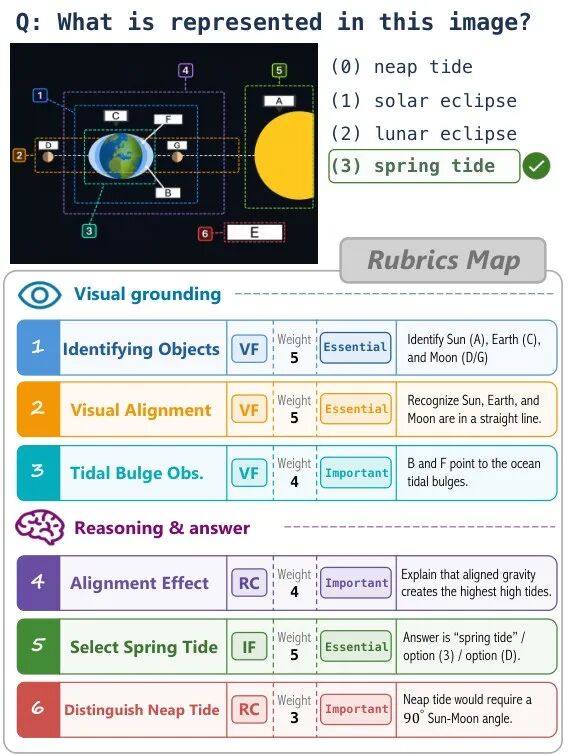
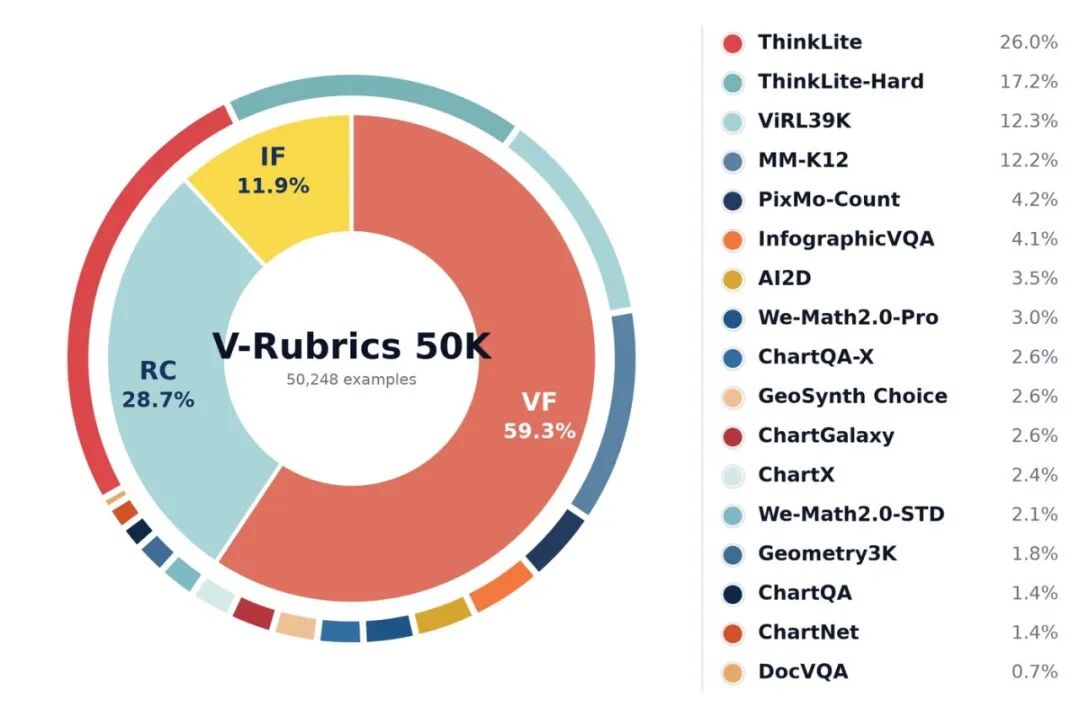
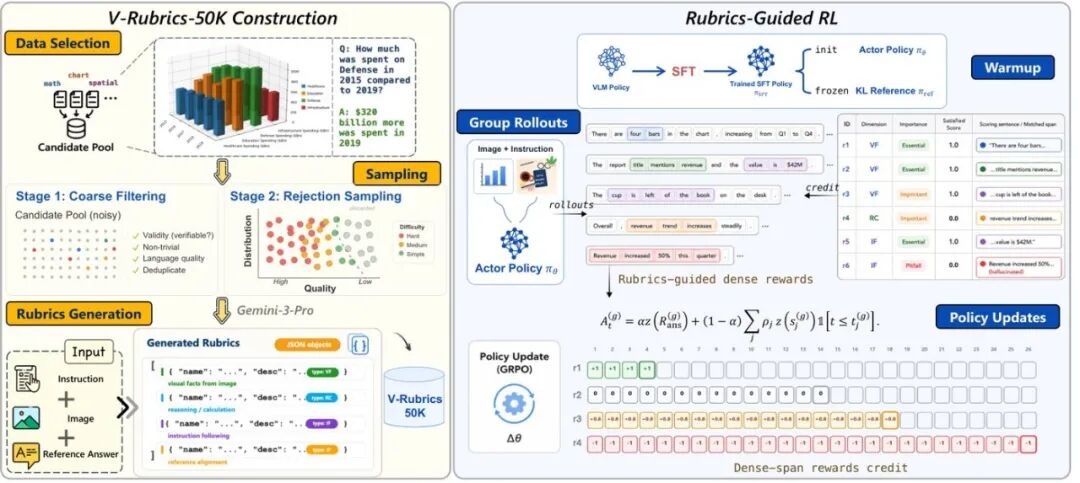
At the end of August, the S-Lab group at Nanyang Technological University, with A*STAR, published V-Rubrics (arXiv:2608.25580, open-sourced as shulin16/v-rubrics). They used Gemini-3-Pro to split the reference answers of 50,000 visual reasoning questions into 352,000 atomic checks. Each checks one thing and becomes a yes/no question, with weights, feeding a GRPO pipeline that trains multimodal models.
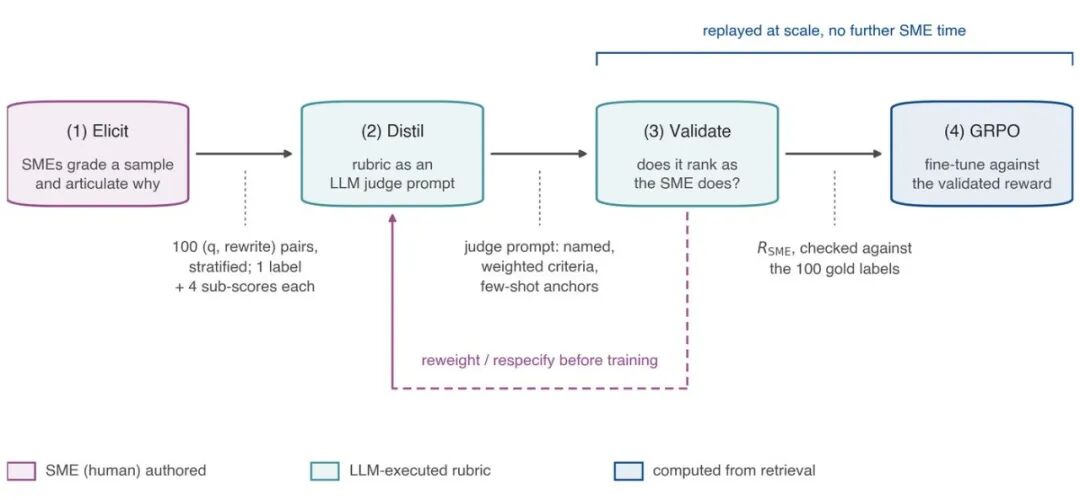
On 17 October, the US asset manager The Vanguard Group and academic co-authors published Expert-Guided Rubrics as Dense Reward Signals for Reinforcement Learning in Non-Verifiable Domains (arXiv:2610.26932), turning the intent understanding, query rewriting and compliance retrieval in financial services — none of it verifiable before — into expert-level rubrics used as dense rewards.
Then AI2 open-sourced DR Tulu (rlresearch/dr-tulu), training a deep-research agent with dynamically evolving rubrics; Tsinghua and Zhipu released CaRR (THUDM/CaRR), which requires a deep-search agent to bind every scoring point to the web evidence that supports it before any credit is given.
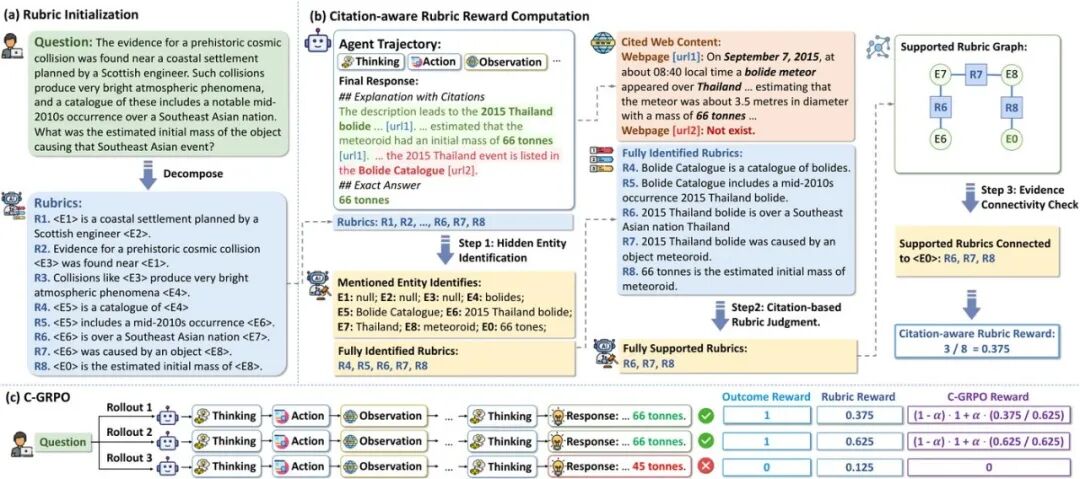
The common thread: stop letting a judge assign one vague impression score, and split the definition of good into dozens of independently verifiable atomic assertions. That is not a rule upgrade; it is a rebuild of the post-training stack.
04Pitfalls in designing scoring rules: notes from the field
At datamining.cloud we have spent the past years building task data and executable evaluation environments for model and agent development. Scoring-rule design is where we have hit the most pitfalls and learned the most.
The "and" trap
Annotation teams naturally write rules like: the model must answer accurately and completely.
It reads fine and grades badly. If an answer is accurate but incomplete, does it score? If it gets half credit, where does the half come from? Two judges will disagree completely.
Our rule now is one criterion checks one thing. Conjunctions such as "and", "at the same time", "as well as" are banned. Accuracy and completeness become two independent checks, each scored on its own.
Credit items with no penalty items
Early rubrics only carried credit: does the answer cover all key sub-questions, plus 5 points if yes.
In real business, some errors cost far more than a correct answer earns. A plausible but wrongly dosed medication recommendation. A patient ID left visible in a compliance document. Impression scoring drowns those errors, and the consequences do not stay small.
So our design rules require penalty items: leaving one patient ID exposed costs 10 points, a missing critical risk warning costs 7. Penalty items make the RL gradient sharply sensitive to those business hazards.
Models game the rules
This is the most underrated problem. When a scoring rule becomes an RL reward, the model is not learning, it is optimizing. It will find ways around the rule that nobody imagined.
Ask for at least three concrete examples and the model learns to stuff in three irrelevant ones. Require citations from the provided material and the model learns to copy long passages without understanding them.
The remedy is iterative patching: run a round of training or evaluation with the first version, analyse the outputs, find how it games the rule, then add a targeted constraint. It usually takes several rounds.
Scoring rules must bind to an evidence chain
In deep research and long-form generation, another frequent problem is that the judge cannot verify factual claims.
A model writes an industry analysis and cites three sources. With no original material to check against, the judge works from its own knowledge and misjudges easily.
The trend is therefore to bind every factual scoring point to a checkable evidence chain. The model does not only give the conclusion; it marks which document, which passage and which data point it came from. CaRR from Tsinghua and Zhipu explores exactly this direction.
05Scoring rules are reshaping the data supply chain
One broader observation. Once a scoring rule moves from grading to training, from one score to a set of atomic points, the effect goes well past evaluation and rebuilds the logic of the model data supply chain.
Data vendors used to deliver questions plus reference answers. The buyer ran exact match or Pass@k and had a score.
What buyers want now is not an answer key but a rule system that grades reliably. The question they ask is: can the tacit experience of a partner reviewing a case, an auditor chasing a false entry, a radiologist reading a scan, be written as dozens of atomic rules a machine can grade?
In mid-October, a leading domestic model vendor and a data hub updated version 2.0 of their professional industry-agent procurement specification. One hard requirement: every long-horizon finance, tax, legal or medical task must ship at least 35 atomic positive and negative rubric items. The constraints are strict: one criterion checks one thing, it must name which deliverable file it checks, and it must include a penalty item aimed at a business hazard.
Whoever can translate a domain expert's tacit judgement into machine-executable scoring rules first holds the core resource of the second half of post-training.
06Summary: scores are products of rules, and rules set the direction of evolution
First, scores are not natural. The same answer measured under different scoring rules produces completely different numbers.
Second, scoring rules evolved from hard rulers to soft rulers to atomic scoring points: exact match, Pass@k, BLEU and ROUGE, LLM-as-a-judge, then multi-dimensional rubrics.
Third, in 2026 the role of the scoring rule changed fundamentally: no longer only an evaluation tool, but a reward signal for reinforcement learning.
Fourth, classical scoring rules cannot handle open-ended tasks. When the 0/1 ruler cannot measure a due-diligence report or a medical analysis, finer instruments are needed.
Which leads to the next question: how should those atomic scoring points be designed for open-ended tasks with no answer key? Part 3 takes that apart.
About datamining.cloud We are a doctoral team from the School of Computer Science, Peking University, producing original task data and evaluation environments for model and agent development, with data services delivered to ByteDance, Alibaba and Tencent. In code engineering, complex logical reasoning and long-horizon sandbox interaction we build anti-cheat independent verification environments, real business test probes and blind test sets for partners, so that inflated sampling does not turn into a bad procurement decision. Website: datamining.cloud. Contact: contact@datamining.cloud
07References
- Tian et al. V-Rubrics: Visual Faithfulness via Rubric-Based Reinforcement Learning. arXiv:2608.25580, 2026.
- Bansal et al. Expert-Guided Rubrics as Dense Reward Signals for Reinforcement Learning in Non-Verifiable Domains. arXiv:2610.26932, 2026.
- Zhang et al. Chaining the Evidence: Robust Reinforcement Learning for Deep Search Agents with Citation-Aware Rubric Rewards. ACL 2026.
- Zheng et al. Judging LLM-as-a-Judge with MT-Bench and Chatbot Arena. ICML 2024.