After Big Tech Builds In-House Data Teams, Is There Still Room for External Data Vendors?
In-house data teams take back acceptance criteria, not all production capacity. The hardest original tasks are pushed to external vendors.
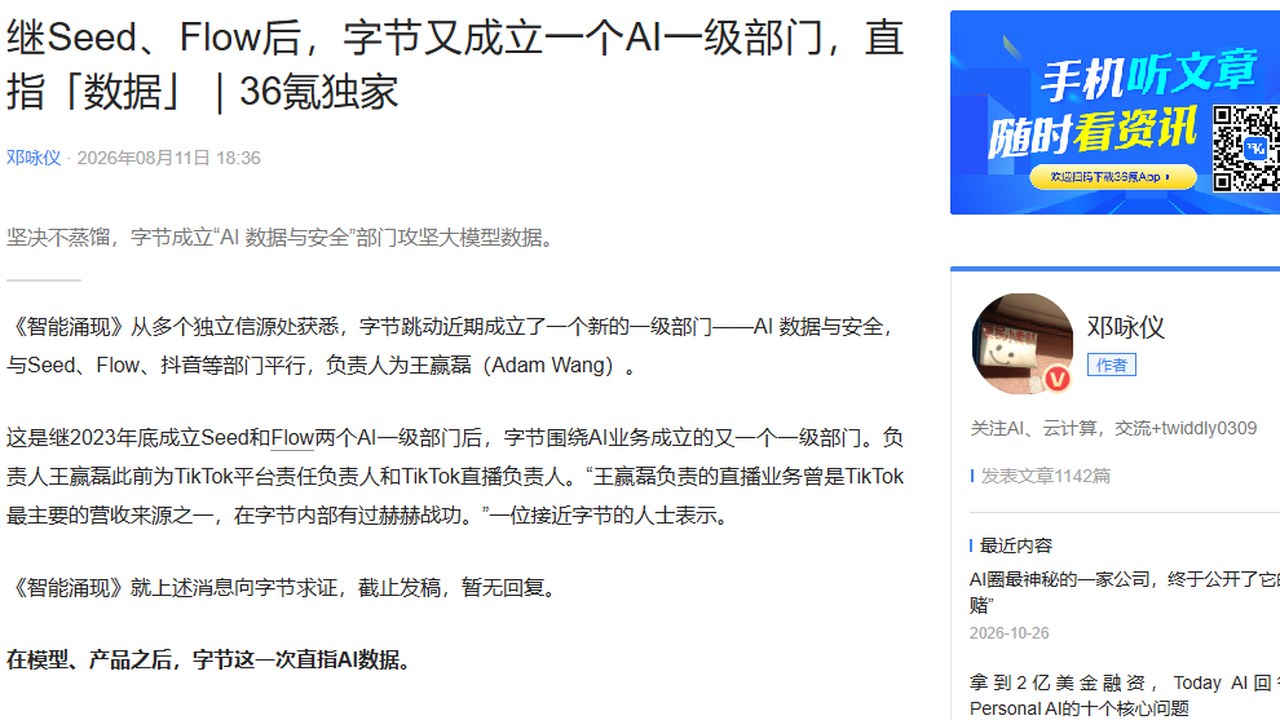
36Kr exclusive: After Seed and Flow, ByteDance has created another first-tier AI department aimed squarely at 'data'
DataMining · November 7, 2026
In the second half of this year, China's data industry has sent several fairly clear signals.
First, ByteDance merged its Global Data team, the group-level data middle platform DMC, and the AI data platform AIDP under Flow into a single first-tier 'AI Data and Security' department, placing it on the same level as Seed, Flow, and Douyin. Then in late September, Tencent Hunyuan launched its own 'Hunyuan Think Tank', openly recruiting experts in a dozen vertical domains to take online assignments. And a look at Alibaba's job pages shows a 40-60K monthly salary for an LLM data procurement specialist, with duties that explicitly include technical due diligence on suppliers and shifting procurement from 'buying data' to 'buying capability'.
Many people in data outsourcing got uneasy at the sight: if big tech has both elevated data to a first-tier department and built its own expert platform, is it about to pull all data production back in-house? Are the good days over for external data vendors?
If you still expect to make money the old way, rounding up a few hundred part-time students and selling static Q&A pairs by the item, then yes, that run is over. But look at what in-house data teams actually do and where they get stuck, and you will find that they have not closed the door on external vendors at all. They are pushing the genuinely high-priced, hard problems outward instead.
0101
To see what external data vendors can still earn, first understand what these in-house data departments have actually taken over.
Two years ago, data buying at Chinese model labs was largely ad hoc. When an algorithm team needed data for training, a researcher would place a small order with a familiar former classmate or an outsourcing crew, a project worth a few hundred thousand RMB, and add more if the results looked fine. Back then a vendor dealt with exactly one person: the algorithm engineer who needed the data in a hurry.
Now budgets sit in the tens of millions of dollars, and the data evaluation team supporting Seedance alone already numbers in the thousands. The old cottage-industry procurement simply cannot turn at that scale.
What ByteDance pulled back in-house when it elevated data and security to a first-tier department comes down to three things: standard-setting, QA operations, and security compliance.
In other words, what in-house teams take over first is not all production capacity, but the right of acceptance.
Today an external vendor delivering to a big tech company no longer faces one easygoing algorithm engineer, but a four-way review by procurement, QA, compliance, and algorithms: algorithms check whether the batch moves the needle on the eval set in a small-scale experiment; QA watches sampling consistency and rework criteria; security and compliance trace where the data came from, whose hands it passed through, and whether there are cross-border or copyright risks; procurement closes by working out unit price and schedule.
Why go to all this trouble to build a permanent organization? Precisely because these companies have found that over the next two or three years, external procurement will not stop; it will keep growing. Without a proper sieve in place first, tens of millions of dollars buy nothing but contaminated question banks and inflated expert trajectories.
0202
So if big tech already has evaluation and data teams in the thousands, plus its own expert platform, why not simply take over production as well?
The reason is simple: internal headcount and assembly-line management are structurally unsuited to original hard problems with high attrition, deep specialization barriers, and wildly fluctuating demand.
In-house expert platforms handle routine text polishing, ordinary translation, basic code labeling, and standard model evaluation very well. Those jobs come with ready-made standards, so hiring a few thousand part-timers paid per item is enough.
But by the second half of this year, the real bottleneck in post-training had already moved.
Models now urgently need long-horizon systems engineering capability, complex repository tasks like Deep SWE and Frontier SWE, or advanced multimodal reasoning in math, physics, and chemistry, such as PhD-level science problems like HLE-VL.
How are such tasks built? Certainly not by sending out a crowdsourcing link and asking part-time experts to fill in a web form.
Take a single qualified original Deep SWE task. The author first has to be an experienced engineer who understands large-scale software architecture. They must locate a complex cross-module defect inside a real project with tens of thousands of lines of code, package the full dependency environment and test dataset needed to reproduce the failure into a standalone Docker container that resets in seconds, and write an independent anti-cheating verifier. Finally, several frontier models are run against it to confirm that no model can slip through by guessing the answer or editing the test script.
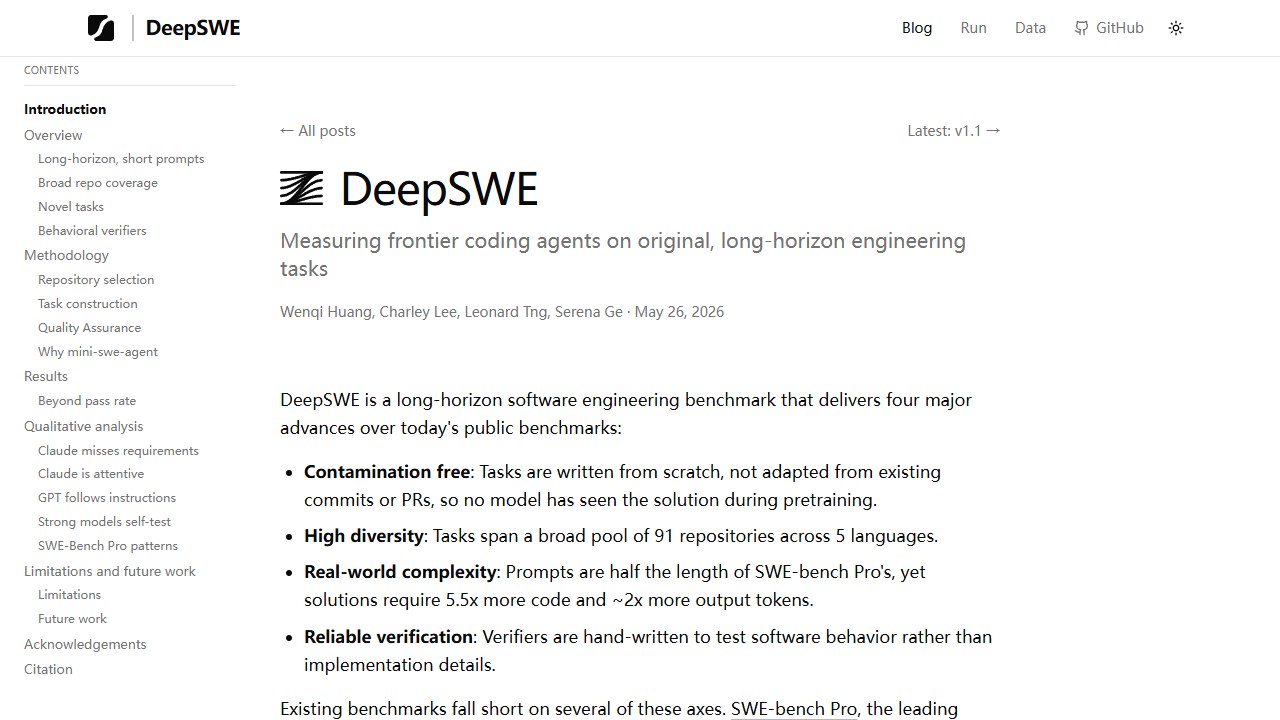
DeepSWE official site: 'Measuring frontier coding agents on original, long-horizon engineering tasks', listing four advances, Contamination free, High diversity, Real-world complexity, and Reliable verification
When we benchmarked Deep SWE-style task data, we ran one comparison: with the same frontier closed-source model, accuracy (ACC) on our original code tasks came in 15 percentage points lower than on comparable data from several other vendors at the time, while the agent reasoning trajectories on our data averaged about 20 turns longer.
Why do models score comfortably and finish in a dozen turns on similar tasks from other vendors, yet drop 15 percentage points in accuracy and need 20 more turns on ours?
Because it is easy to make a task look complex on the surface, just have an outsourcing crew pad it out by item count. But placing a task exactly at the capability boundary of a frontier model, forcing a complete trajectory of long-horizon error tracing and cross-file backtracking, is research-grade precision work. An in-house operations team carrying a monthly throughput KPI simply cannot spend weeks with a few PhDs grinding over a dozen problems, refining environments and edge cases the way a research project demands.
0303
Beyond long-horizon code and sandbox environments, what in-house teams find even harder to absorb is cross-disciplinary verification logic.
Buying data used to mean taking delivery of a JSON file with a question on the left and an answer on the right. With domain-specific post-training data, the most valuable part is often not the answer but the proof that the answer is correct.
In multimodal scientific reasoning, for example, we built a set of organic chemistry and history-of-mathematics/physics task samples modeled on the capability requirements of HLE-VL.
In the chemistry problem on reaction barriers and stereoselectivity, the model must read both the reaction-path energy diagram (16.9 and 29.6 kcal/mol) and a four-quadrant steric hindrance diagram to identify the correct kinetic branch and exact configuration. In another materials problem, it must first select the structural state from donor/acceptor material images, then compute charge transfer and the average oxidation state of ruthenium (Ru) per formula unit, and finally output three mutually constrained exact scores.
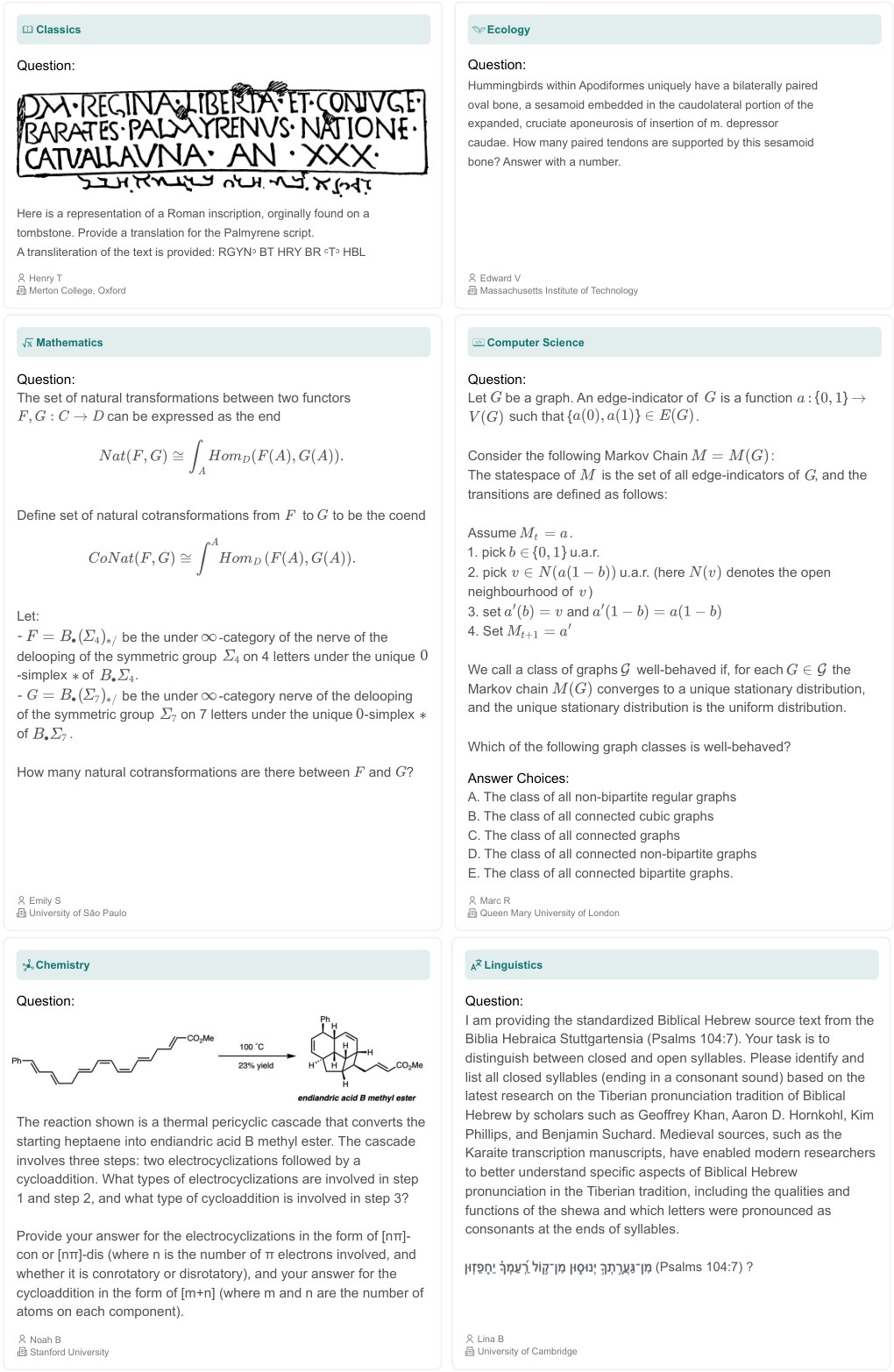
Hand such problems to an ordinary labeling platform and even the reviewers cannot read what the arrows and steric effects in the figures mean, let alone check whether the model misread a branch while reading the image or miscalculated valence in the conservation step. They can only be authored from scratch by competition coaches and PhDs in the relevant field, then filtered layer by layer with solvers, cross-model validation, and double-blind expert review.
The same holds for professional workflow agents, medical epidemiology investigations and long-form legal due diligence, and for embodied intelligence.
One public-health task sample we built asks the model to read five source documents, with one deliberately unnecessary distractor table mixed in, and produce two Word reports and one Excel summary. Accepting such a task requires delivering a 15-item scoring rubric and an expert evidence index alongside it: not only do the numbers across the three files have to reconcile, but an explicit negative weight applies whenever the model hallucinates information absent from the sources as established fact.
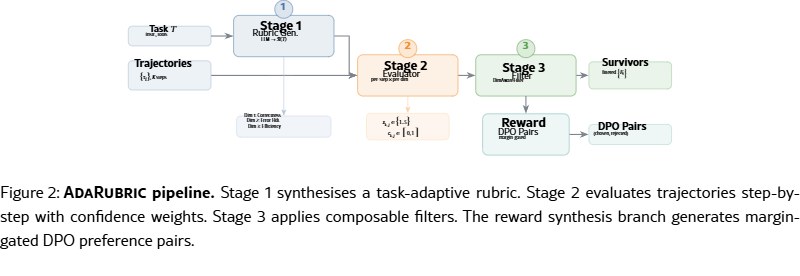
In embodied intelligence, both object grounding annotation in real-machine scenarios and the off-state correction samples most scarce in navigation DAgger post-training require a team that understands the algorithm logic to perform double-blind review against real-machine coordinates and action boundaries.
No big tech company can maintain a full bench of PhD item writers in organic chemistry, knot topology, epidemiology, high-speed circuits, and robot control all at once. A capability that urgently needs work this quarter may change direction next quarter, so a large permanent in-house team never pays for itself.
0404
Broken down this way, the path left for external data vendors after big tech builds in-house data departments is actually quite clear.
What is being rapidly pushed out is the middleman living on information asymmetry and headcount markups. The old routine, getting a requirement from an algorithm team through connections, passing it to a local labeling base or a group of part-time students, taking a 30% cut, and shipping the result, cannot even clear the first trial batch under a four-way procurement, QA, compliance, and algorithm review.
Conversely, external vendors that can actually absorb those tens of millions of dollars are converging on two directions:
First, moving from selling data by the item to delivering turnkey evaluation gains. Big tech now calculates very precisely: once your data is delivered and the ablation runs, how many points did it add on the internal held-out test set? That means a vendor needs its own algorithm team that understands model training and evaluation, one that has already run environment packaging, anti-cheating tests, and cross-model validation before delivery, and screened out bad problems and gameable scoring rules itself.
Second, specializing in the high-density original hard problems that an in-house assembly line cannot produce. The more generic the environment, such as the 7,000-plus basic RL environments open-sourced by Xiaomi, the less it is worth. The more a task sits at the capability boundary of SOTA models, long-horizon code repositories, scientific reasoning problems that depend heavily on visual structure, professional agent workflows with strict evidence checks, the higher the premium. Industry research puts exclusive custom environments at four to five times the price of non-exclusive generic ones, with a single complex software engineering task selling for over ten thousand dollars.
Ultimately, elevating data procurement to a first-tier department is not about eliminating external vendors. It is about ending the wild-west phase the data industry has been through over the past two years.
The competition used to be about who could most quickly claim 50,000 registered experts, even if most of them could not understand the questions. From here on it is about who can produce hard problems that force frontier closed-source models and Claude to grind through dozens of turns. Once the buyer's measuring stick becomes professional and rigid enough, outsourcing shops that subsist on headcount will naturally exit, while technical vendors who understand model weaknesses and can build real problems and strict criteria from scratch find themselves in the strongest pricing position they have ever had.
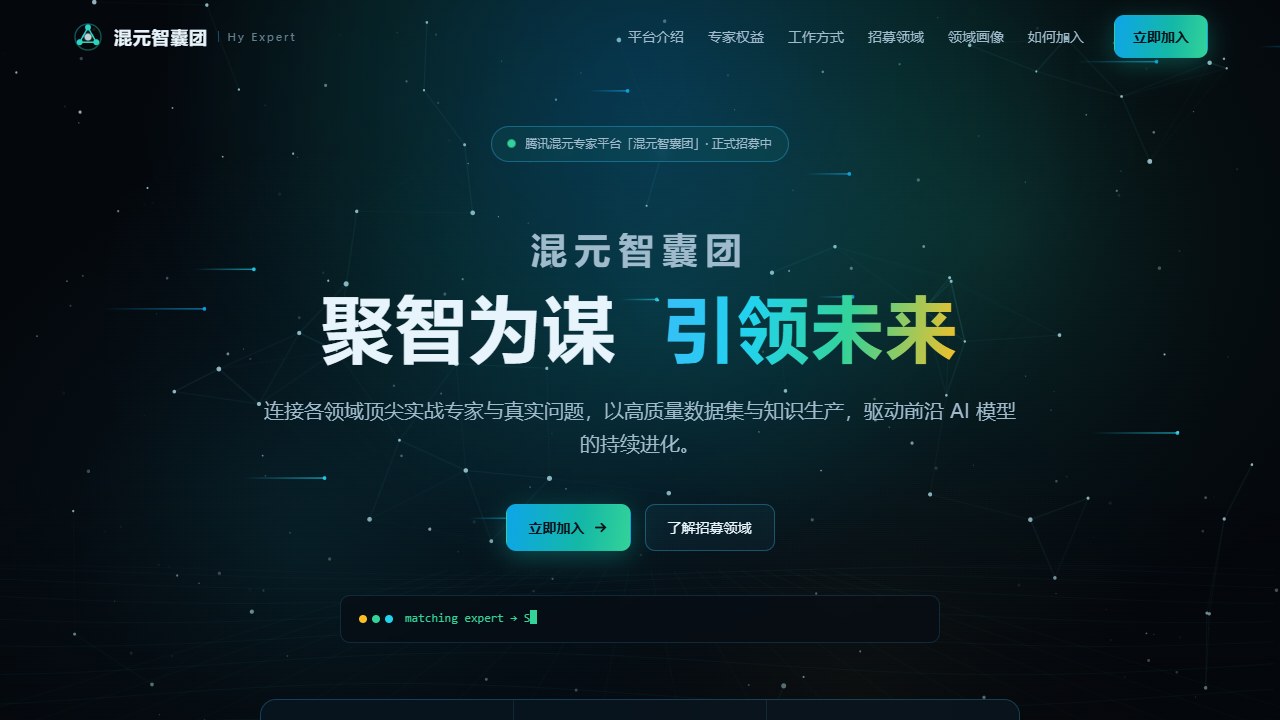
Tencent Hunyuan Hy Expert homepage: 'Pooling wisdom to lead the future', connecting top practitioners across domains with real problems
We (DataMining / datamining.cloud) are a team of PhD students from the Institute of Software, School of Computer Science at Peking University, focused on high-quality original task data for LLM and agent development. We have provided data services to leading technology companies including ByteDance, Alibaba, and Tencent. If your data or algorithm team is building training and evaluation sets for complex code (Deep SWE / Frontier SWE), long-horizon professional agents, HLE-VL-level multimodal reasoning in math, physics, and chemistry, or embodied intelligence, we would be glad to discuss your original task data requirements around specific target capabilities and acceptance criteria.
About DataMining Founded by PhD students from the Institute of Software, School of Computer Science at Peking University, we focus on high-quality original task data and executable evaluation environments for LLM and agent development, and have served leading technology companies including ByteDance, Alibaba, and Tencent. We deliver not only data but industrial-grade Rubric and Harbor Task verification systems. Long-horizon code and engineering simulation: Deep SWE, Frontier SWE, Frontier-Eng, ALE / Terminal-Bench, supporting 200 tasks per week with stable delivery in 7 working days. Extreme math/science and professional agents: a strict HLE-VL multimodal production line; Harvey LAB, Automation Bench, Toolathlon, and a pack of 35+ atomic-level Rubrics for industry workflows. System infrastructure and real-machine embodiment: standardized Win11 / Ubuntu desktop agent VM images, plus million-scale customized real-machine production lines for embodied Grounding / SFT / DAgger. If your data or algorithm team is building training and evaluation sets for complex code, long-horizon professional agents, HLE-VL-level multimodal reasoning, or embodied intelligence, we welcome a conversation about your target capabilities and acceptance criteria. 🌐 Website: datamining.cloud|📮 Sample requests and technical contact: contact@datamining.cloud
📚 Image Sources
36Kr: 36kr.com/p/3934936980667776
DeepSWE official site: deepswe.datacurve.ai/blog/deepswe
Humanity's Last Exam, arXiv:2501.14249v8, Figure 2 (original)
AdaRubric, arXiv:2603.21362v1, Figure 2 (original)
Tencent Hunyuan Hy Expert: hyexpert.tencent.com
All 5 images are public originals from news pages or papers, inserted in reading order; captions describe only what is visible in the image.