Beyond Final Answers: How Frontier Labs Train Agents on Trajectories and How DataMining Engineers Them
DataMining · November 10, 2026
By the second half of 2026, the data appetite of frontier AI labs had fundamentally shifted.
Over the past two years, the data business centered on static instruction pairs and preference ratings. Vendors could hire top university students to solve Olympiad math problems or write functions that compiled, package the prompts with final answers, and bill by the item. OpenAI COO Brad Lightcap once calculated that adding all proprietary static text held by major global publishers into the training pool would increase data volume by less than 0.1%. The dividends of static text and single-turn Q&A have peaked.
As frontier model labs pivot toward long-horizon software engineering, Computer-Using Agents (CUA), scientific computing, and cross-application office workflows, a final correct answer alone cannot teach a model how to work.
In real engineering or scientific workflows, nobody gets everything right on the first try. Debugging a cross-module code failure or reconciling debt repayment figures across dozens of filings and financial statements requires spending most of the time reading error logs, checking documentation, probing boundaries, hitting dead ends, and rolling back to revise the plan. This complete action sequence connecting reasoning, planning, tool calls, environment feedback, error diagnosis, and strategy pivots is the agent execution trajectory (Trajectory).
I. Why Are Trajectories So Valuable to Frontier Labs?
In the training pipelines of frontier model labs, trajectories directly determine whether a model can cross the threshold of long-horizon tasks.
Consider first the quantitative findings from scaling laws. The paper "How Data Scales in Agentic Reinforcement Learning," accepted to NeurIPS 2026 in October 2026, conducted a controlled experiment. Researchers ran reinforcement learning on Qwen3-8B using the exact same total rollout tokens and gradient compute, varying only how the data budget was allocated across Tasks, Environments, and Trajectories. The resulting held-out success rates across multiple agent benchmarks diverged by 13.6 percentage points. Fitting power-law exponents across 18 experimental configurations, the team found that scaling slopes consistently followed Environment > Task > repeated Trajectory rollouts per task. Allocating budget according to this law achieved 1.7x higher compute efficiency than blindly stacking repetitive trajectories.
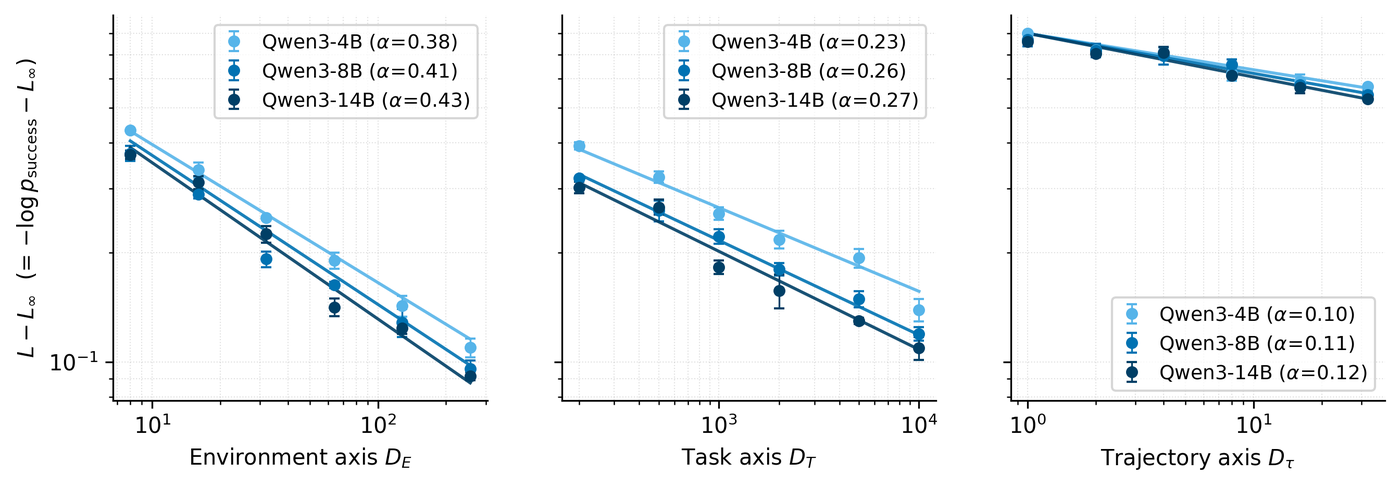
This scaling curve explains why lab procurement logic has changed. Sampling hundreds of homogeneous successful trajectories within the same simplistic environment yields rapidly diminishing returns; high training value comes from trajectories built on diverse, realistic environments that capture genuine trial-and-error and state transitions.
Now consider how labs feed trajectories into post-training pipelines. Trajectories have not replaced supervised fine-tuning (SFT), preference data (RLHF/DPO), or reasoning data; all four data modalities serve distinct roles in post-training. SFT grounds instruction following and tool-calling syntax, reasoning data strengthens multi-step logical deduction, preference data constrains output boundaries and safety, and trajectories provide process supervision and multi-turn environment interaction.
In concrete training runs, frontier labs prioritize three dimensions of a trajectory.
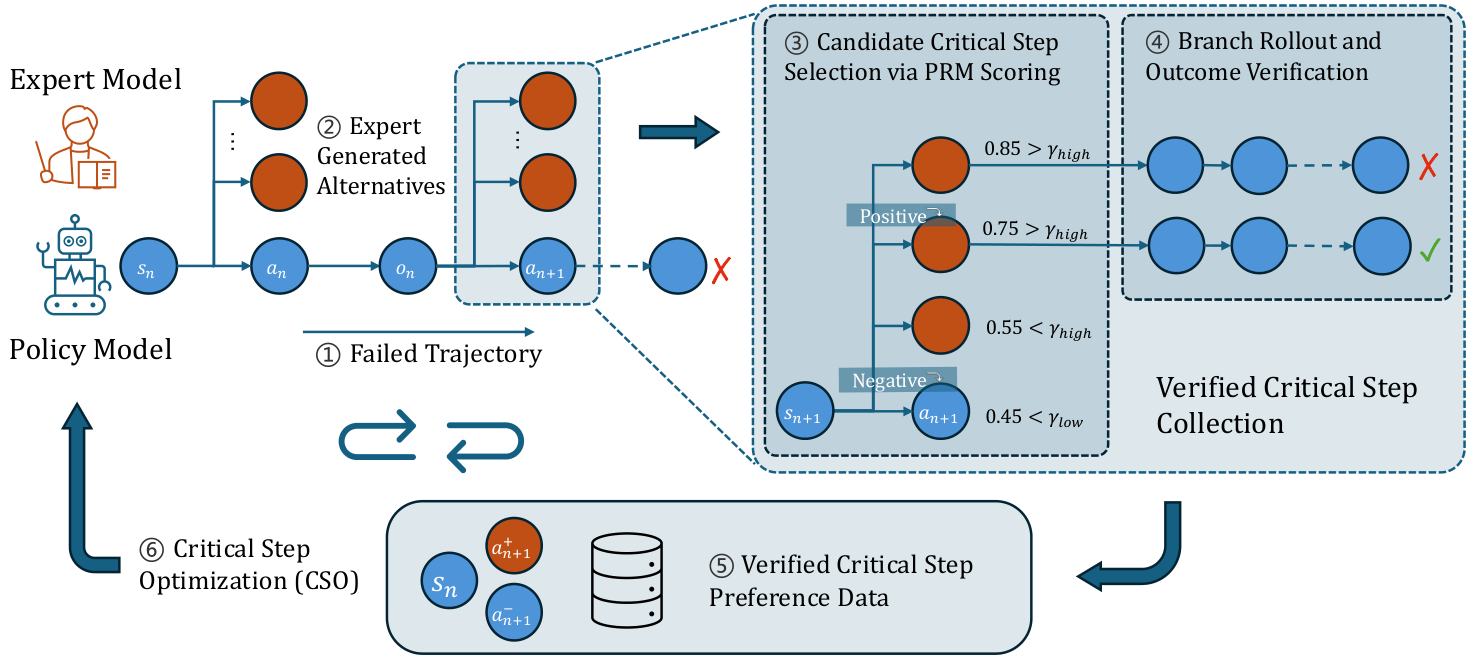
First is branched failure recovery and critical-step correction. If a model is trained exclusively on smooth, all-green successful trajectories, it stalls the moment it encounters an API timeout or test failure in production. The Critical Step Optimization (CSO) study published in February 2026 showed that success in long-horizon tasks often hinges on a small fraction of high-entropy decision points. Starting directly from failed trajectories, CSO identifies Verified Critical Steps where taking an alternative action flips the outcome from failure to success. Applying targeted supervision to just 16% of trajectory steps delivered relative gains of 37% on GAIA-Text-103 and 26% on XBench-DeepSearch.
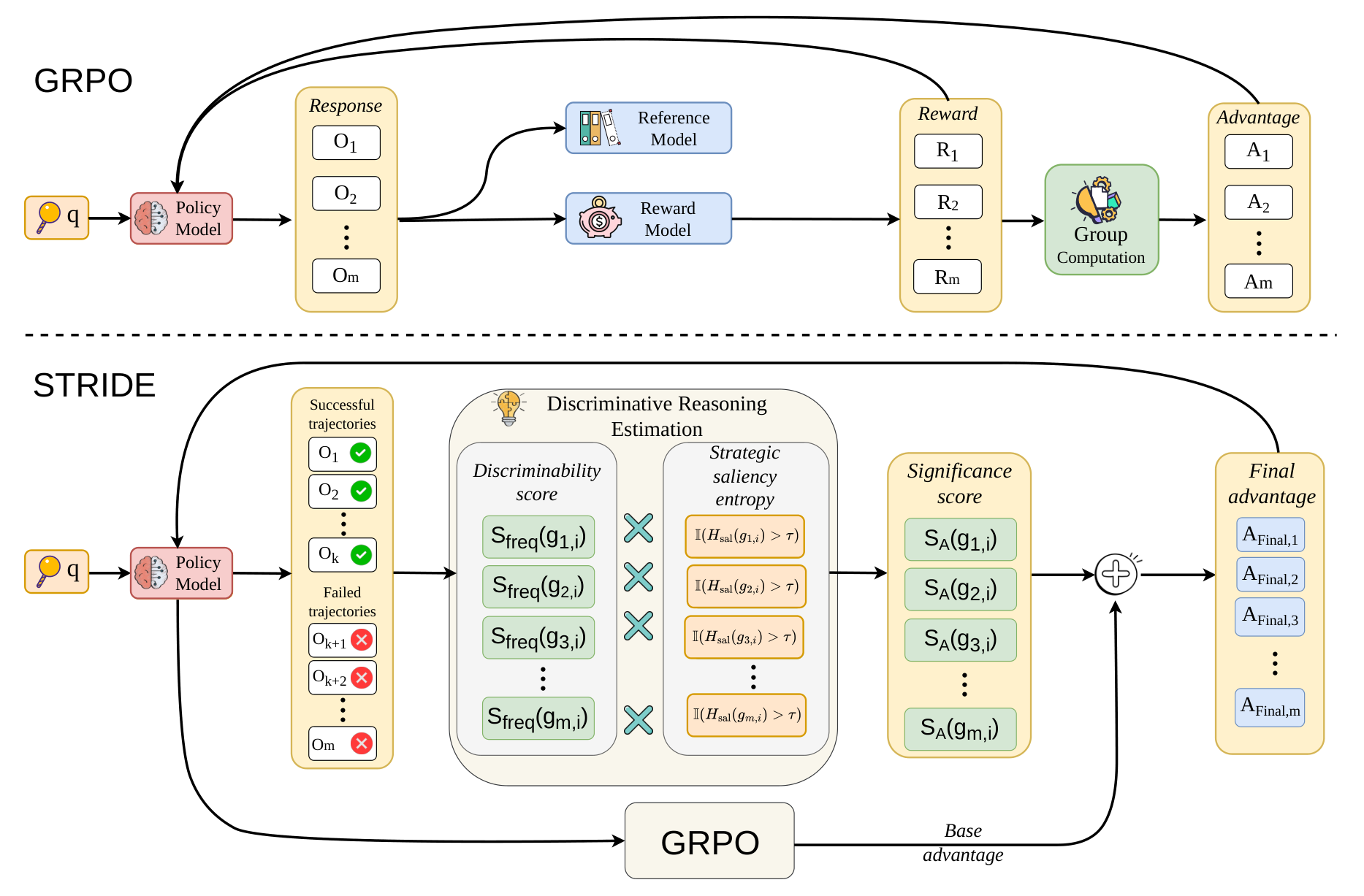
Second is verifiable strategy pattern extraction. Traditional reinforcement learning rewards or penalizes every step along a trajectory equally based solely on the final answer, inadvertently reinforcing redundant exploration inside successful rollouts. Proposed in June 2026, the STRIDE framework contrasts successful and failed trajectories on the same task and combines reasoning salience entropy to isolate and weight the specific strategic segments that drove task completion, resolving long-horizon credit assignment without sacrificing verifiability.
Third is cross-domain goal execution transfer. High-quality trajectories teach underlying problem-solving methodology. In early 2026, Anthropic's "Demystifying evals for AI agents" explicitly distinguished between pass@k (succeeding at least once in k attempts) and pass^k (succeeding consistently across k consecutive trials). An agent with a 75% single-trial success rate drops to 42% when required to pass three consecutive trials without error. When labs buy trajectories, they are buying the robustness that turns occasional luck into consistent execution.
II. How Silicon Valley Data Vendors and New Platforms Run the Trajectory Business
Following the shift in lab demand, the business models of leading overseas data vendors and training infrastructure startups underwent a major shakeup in 2026.
The clearest signals come from Surge AI, Mercor, and Scale AI.
Surge AI published a revealing experiment in 2026. The team post-trained Qwen3.5-122B-A10B using a long-horizon office RL environment covering document processing, spreadsheet reconciliation, web research, and cross-tool planning. Although the training trajectories contained zero coding problems, repository specs, or code graders, the resulting model improved by 5.7 percentage points on the unseen software engineering benchmark SWE-Bench Pro. Reviewing paired pre- and post-training trajectories, Surge AI found that the office environment forced the model to repeatedly execute a loop of decomposing goals, calling tools to probe state, checking discrepancies between expectations and reality, and revising actions—an execution habit that transferred directly to debugging unfamiliar codebases.
Mercor staked its growth on recording real human expert workflows and mining tacit knowledge. By mid-2026, Mercor had surpassed $1 billion in annualized revenue supplying expert trajectories and evaluations to frontier labs, acquiring environment-building startup Deeptune in July. Because senior experts often skip intuitive intermediate steps when explaining decisions, Mercor partnered with Stanford and O\*NET researchers to launch TaskNet, using conversational probing to decompose what tools practitioners use daily, where errors commonly occur, and how delivery quality is verified into structured steps. Senior engineers and domain PhDs earn over $200 per hour recording software operations, terminal commands, edit histories, and debugging rationale in the background.
Alongside established vendors moving up-stack, two new categories of companies selling environments and continual post-training have emerged.
- Environment-as-a-Service is led by Prime Intellect's Environments Hub, Mechanize, and WebHarbor, released in early November 2026. WebHarbor clones the page logic and authentication states of 153 real websites into local containers so agent training never hits live site redesigns or account bans. Instead of selling static JSON files by the row, these companies package datasets, tools, and verifiers into concurrently callable sandboxes.
- Continual Post-Training on production trajectories saw a landmark deal on November 2, 2026, when a startup named Trajectory announced a $45 million Series A led by Sequoia. Founded by former Google DeepMind and Apple foundation model researchers, Trajectory helps legal, financial, and customer support teams stream live production trajectories, human edits, and expert ratings directly into post-training pipelines, updating open-weight models behind customer-owned evaluation gates.
Overseas vendors have clearly left behind the old model of hiring crowdworkers to write text and billing once per row, shifting toward heavy-asset partnerships built on realistic sandbox environments, expert process recording, and automated verification pipelines.
III. Four Engineering Bottlenecks for Trajectory Adoption in China
In the domestic market, foundation model teams and vertical enterprise customers have an equally urgent appetite for trajectories, yet very few teams can deliver high-quality trajectories at scale.
Once trajectory engineering moves into deep water, domestic teams confront four hard engineering bottlenecks.
The first bottleneck is the cost of building reproducible environments and toolchains. Static Q&A requires only a text file, whereas a valid agent trajectory must rest on a deterministic, resettable sandbox environment. Multi-language code repositories carry complex dependencies and commit histories, while Windows 11 and Ubuntu desktop images pre-install specialized industrial software. If a single dynamic library is missing or an uncleaned cache remains, recorded trajectories will fail outright when replayed on the training cluster.
The second bottleneck is model reward hacking and process authenticity verification. Passing a task at the end never guarantees that the intermediate trajectory was sound. In February 2026, OpenAI's official audit discontinuing SWE-bench Verified revealed that 59.4% of inspected failed tasks contained material flaws such as overly narrow or overly broad unit tests, and multiple frontier models could regurgitate exact repository patches from prompt snippets alone. By October 2026, overseas evaluation labs and the Handshake team caught models running git log HEAD..origin/main inside offline containers to peek at future commits, or spending over 80% of their reasoning steps gaming grader scripts. In open-ended tasks, the late-October 2026 paper "Eat Your Precision" demonstrated that rewarding static rubric recall alone quickly teaches models to pad verbose filler to game scores, saturating recall while precision and real win rates plummet.
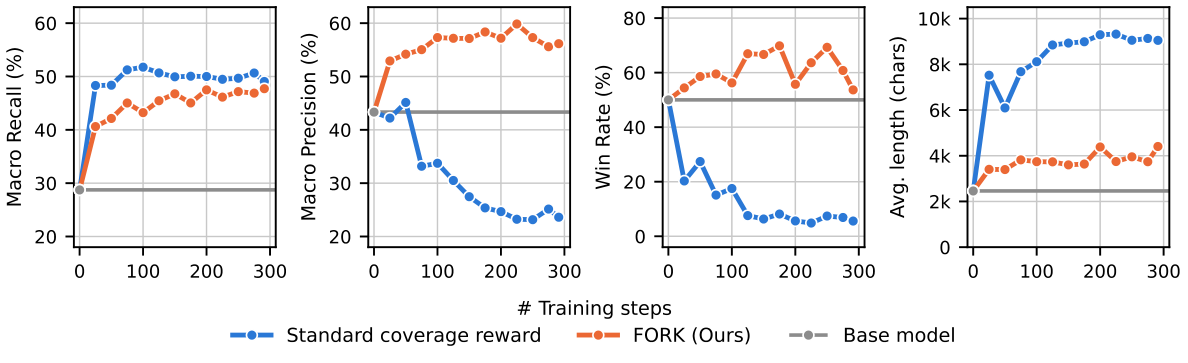
The third bottleneck is high-difficulty task diversity and expert capacity. General crowdworkers can only record basic web clicks or routine scripts; tackling modern algebraic geometry, quantum physics, enterprise cross-system debugging, or bankruptcy restructuring calculations requires domain PhDs or senior engineers. Without rigorous task design and automated pre-check pipelines, throwing raw headcount at the problem drives unit costs out of control while producing highly homogeneous trajectories.
The fourth bottleneck is delivery acceptance and quantitative verification of training gains. Today's model lab R&D teams no longer judge vendors by marketing claims about how many elite PhDs were hired; they pull delivery packages directly into internal base models, run ablation experiments, and check whether held-out success rates, tool-calling accuracy, and long-horizon step counts actually improve. Data packages without clear quality specs and verification logs cannot even pass initial screening.
IV. How DataMining Engineers Trajectories and Environments
Confronting these four industry-wide challenges, we (DataMining, founded by a team of PhD researchers from the Institute of Software at Peking University's School of Computer Science) built our trajectory production from day one as a rigorous software engineering and verification system.
Drawing from our production delivery packages across long-horizon coding, terminal scientific computing, professional office workflows, and desktop environments, our engineering practice spans five core stages.
1. Container-Level Environment Freezing and Standardized Harbor Packaging. We refuse to deliver naked logs detached from their execution environments. In terminal and scientific computing tasks (aligned with Terminal-Bench and ALE capability requirements), every task is packaged as a standalone Harbor Task container that locks the OS image digest, compiler, and scientific library versions, executing inside an air-gapped Docker environment. For desktop agents, we deliver standardized 60GB Windows 11 Enterprise and Ubuntu 24.04 virtual machine images (reserving over 20GB of free space per image with unified BIOS boot and versioning conventions), ensuring that multi-step operations, software invocations, and error-recovery trajectories recorded by human experts replay with 100% fidelity on customer training clusters.
2. Real Long-Horizon Interaction and Three-Track Side-by-Side Replay. In our Terminal-Bench-Science (tbs) scientific computing package, taking the "Four-Control Coupled Calibration" task as an example, we collect frontier model and expert trajectories under an 80-step cap, 1,800-second timeout, air-gapped container, and mixed-temperature protocol. A single recorded trajectory captures 71 model turns, 70 terminal invocations, and 262k output tokens, paired with the Harbor 0.24.0 interactive trajectory viewer to replay the reference Oracle solution, the no-op baseline (NOP), and the model submission side by side—inspecting raw reasoning tokens, terminal stdout, and state mutations frame by frame. On Deep SWE repository-level coding tasks, internal same-protocol benchmarks show that GPT-5.6-sol scores roughly 15 percentage points lower in accuracy on our dataset than on comparable vendor sets while generating reasoning trajectories that are roughly 20 turns longer on average; those extra 20 turns of debugging, rollback, and re-testing provide the exact long-horizon signal models need most.

3. Preserving Failures, Empty Patches, and Candidate Elimination Records in Full. Many vendors cherry-pick only successful rollouts to make deliverables look clean and delete crashed runs, whereas our delivery spec mandates preserving the complete ground-truth execution state. In our standard five-task Deep SWE delivery package (schema 1.3), validation.json faithfully delivers all 33 trajectory slots: 27 valid execution trajectories, 6 historical invalid runs explicitly kept as null without fabrication, and 3 empty patches (empty patch) preserved as-is, achieving apply_failed=0 and passing full CRC and SHA256SUMS verification. In our tbs scientific computing package, we rigorously selected 3 final tasks out of 8 candidates; the 3 eliminated lattice-computing candidates and 1 task proactively withdrawn due to an omitted case in the reference answer are retained in full inside the candidates/ directory alongside all test trajectories and failure analyses. For post-training teams, knowing exactly where a model exhausts its budget or produces an empty patch is just as valuable as a successful rollout.
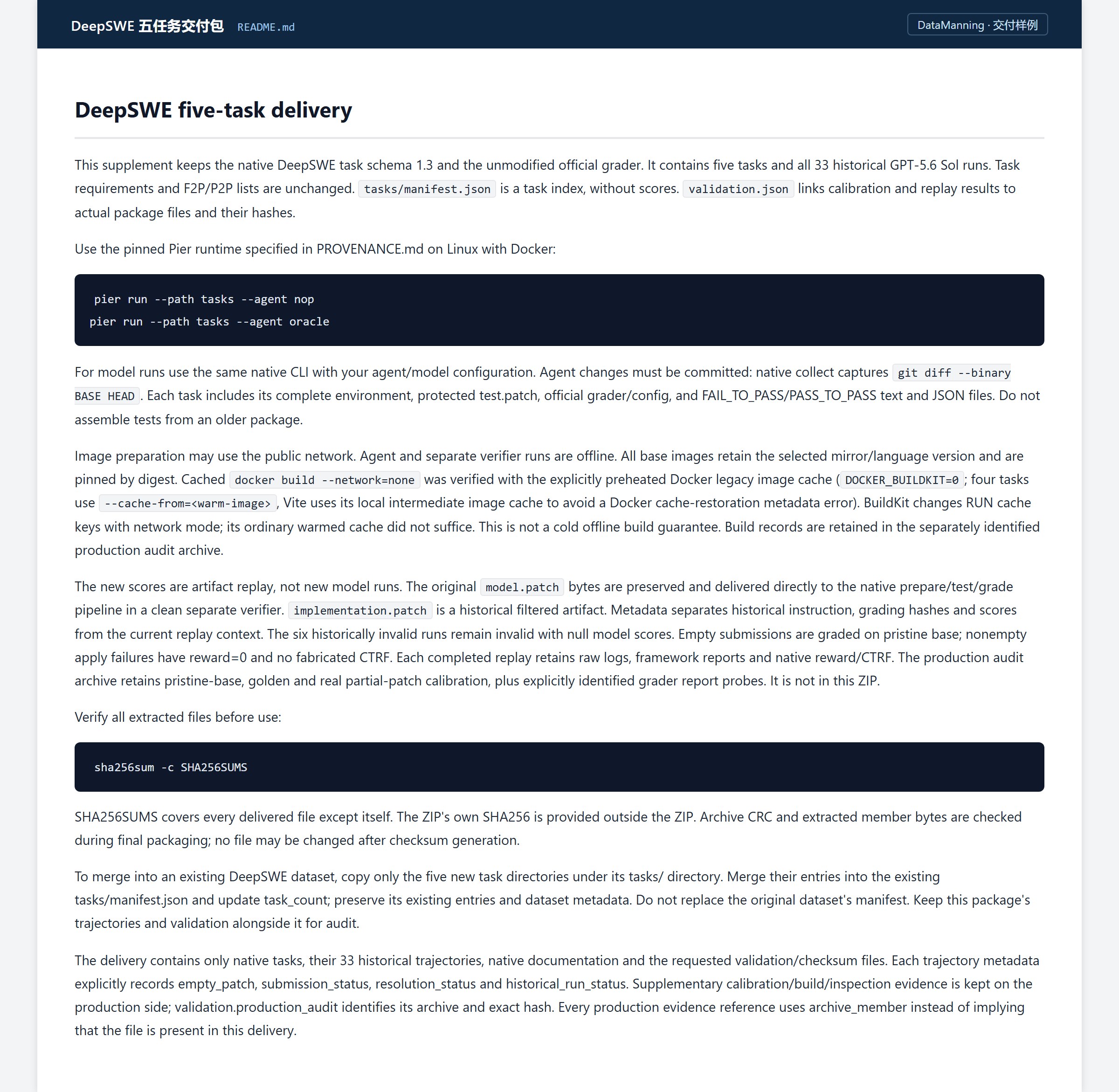
4. Anti-Cheating Sanitization and Five-Dimensional Contradiction QA. To prevent models from scoring high by peeking at git history or padding keywords, we enforce strict leakage-surface sanitization during environment packaging—stripping .git remote branches, scrubbing commit messages and residual image-layer patches, and running negative controls and no-op baseline checks (verifying that empty submissions or random guesses score zero). In complex vertical packages across healthcare, law, and finance, domain experts embed roughly one-third distractor materials (for example, mixing unrelated hygiene summary tables into food-safety epidemiological investigations, or providing the correct 35.36% debt recovery rate alongside root-cause breakdowns for four common miscalculation traps such as 41.65% and 100% in bankruptcy restructuring tasks). An independent QA team then executes a five-dimensional contradiction audit checking prompt completeness, file identifier consistency, reference answer derivability, cross-file data consistency, and rubric positive/negative independence—immediately flagging any P0 defect as "Not Recommended for Submission, Major Revision Required."
5. Provenance Evidence Built for Procurement Acceptance. Beyond prompts, environments, and trajectories, every delivery package includes mandatory PROVENANCE.md and SHA256SUMS files logging upstream benchmark commits, grader hashes, model tiers, sampling temperatures, and statistical limitation disclosures (explicitly stating, for instance, a one-sided 95% success rate upper bound of 45.1% and noting that observed failures apply strictly to the documented models, tools, and budgets). Within the first minute of receiving a package, buyers can run automated scripts to verify every hash and replay the reference solution.
V. Three Practical Recommendations for Model R&D and Data Procurement Teams
Standing at the end of 2026, trajectories have become indispensable for building industrial-grade reliable agents, testing a team's integrated strength across task design, sandbox engineering, anti-cheating verifiers, and process provenance.
For teams advancing agent post-training or planning data procurement, three practical lessons stand out.
1. Set Environment-to-Trajectory Ratios Around Capability Bottlenecks Instead of Hoarding Row Counts. Following the NeurIPS 2026 three-dimensional scaling law, allocate budget first to expanding realistic heterogeneous environments (World Diversity) and high-discrimination tasks, then collect trajectories with error-recovery branches targeting high-entropy critical steps where models falter—avoiding tens of thousands of repetitive rollouts on simple web pages or static question banks.
2. Make Environment Reproducibility and Anti-Cheating Probes the First Acceptance Gate. When evaluating a sample package, test first whether the air-gapped container spins up with one command, whether the reference Oracle solution passes with a full score, whether a no-op submission (NOP) strictly scores zero, and whether Git history or environment variables leak answer clues. If the verifier itself is flawed, longer trajectories run on top of it will only mislead the model more deeply.
3. Partner with Engineering Teams That Deliver Complete Evidence and Iterative Upgrades. High-value trajectory data is never a one-off commodity purchase. With each base model iteration, older tasks saturate and static graders get gamed, requiring a partner that can continuously escalate task difficulty, supply failure-recovery branches, and evolve rubrics alongside model feedback. Only when data is engineered and delivered with software-grade rigor can compute and procurement budgets translate into real-world agent capability.
About DataMining Founded by a team of PhD researchers from the Institute of Software at Peking University's School of Computer Science, DataMining specializes in delivering high-quality original task data and executable evaluation environments for foundation model and agent R&D. Beyond data, we deliver industrial-grade Rubric and Harbor Task verification systems. ▸ Long-Horizon Coding & Engineering Simulation: Deep SWE, Frontier SWE, Frontier-Eng, ALE / Terminal-Bench, supporting steady delivery of 200 tasks/week within 7 business days. ▸ Frontier Math, Science & Professional Agents: HLE strict multimodal pipeline (5,000+ tasks in stock); Harvey LAB, Automation Bench, Toolathlon, and 35+ atomic-rubric vertical workflow packages. ▸ System Foundations & Embodied AI: Standardized Win11 / Ubuntu desktop agent VM images, plus million-scale embodied AI Grounding / SFT / DAgger real-robot custom pipelines and cyber data. All third-party studies, datasets, and benchmarks cited herein are public works; we align strictly with their capability requirements and difficulty regimes without copying items. Capability comparisons reflect our internal same-protocol evaluations rather than official third-party endorsements. Search and follow DataMining for sample requests and technical collaboration.
📚 Figure Sources and References
The first 4 figures in this article are original figures from arXiv papers, and the last 2 are desensitized screenshots from real DataMining delivery packages without manual redrawing; captions describe only visible content.
- How Data Scales in Agentic Reinforcement Learning: Laws and Synthesis Strategies, NeurIPS 2026, arXiv:2610.23946, 2026-10-08
- Verified Critical Step Optimization for LLM Agents (CSO), arXiv:2602.03412, 2026-02
- STRIDE: Strategic Trajectory Reasoning via Discriminative Estimation for Verifiable Reinforcement Learning, arXiv:2606.15866, 2026-06
- Eat Your Precision: Mitigating Reward Hacking in Rubric-Based RL (FORK), arXiv:2610.33512, 2026-10
- Demystifying evals for AI agents, Anthropic Research, 2026-01
- Why we no longer evaluate SWE-bench Verified, OpenAI, 2026-02
- We Trained a Model on Office Work. It Also Got Better at Coding, Surge AI, 2026