The Second Half of Post-Training: Whoever Controls the Scoring Rules Controls Model Evolution
Scores come from scoring rules, not from nature. In 2026 these rules became RL rewards, and atomic grading points are reshaping post-training.
01Lecture 2: Scores Do Not Exist Naturally - They Are Produced by Scoring Rules
DataMining 德塔曼宁 · November 2026
In the previous lecture we broke Benchmark down into exam papers for different subjects: MMLU for knowledge recall, GSM8K and MATH for mathematical reasoning, HumanEval and SWE-bench for code engineering, and Chatbot Arena for human preference.
But once you have the exam papers, the next questions follow: who grades them, how are they graded, and can the grading ruler itself go wrong?
Many readers without a technical background assume that a correct answer earns 1 point and a wrong one earns 0, and that the score is an objective fact. In the evaluation and training systems of large models, however, a score is never an objective truth that exists on its own; it is an output produced by a specific scoring rule (Metric / Scoring Rule).
Scoring rules define what counts as correct, and therefore indirectly determine the direction in which a model evolves. Understanding this is what lets you read the logic behind leaderboards, and what lets you make sense of the quiet paradigm shift taking place across the post-training industry in 2026.
021. The Hard Ruler for Objective Questions: From Exact Match to Pass Rate
1.1 Exact Match: The Simplest Way to Grade
For multiple-choice questions (such as MMLU) or fill-in-the-blank questions, the most intuitive scoring rule is Exact Match. The model's output must be completely identical to the reference answer, down to the last punctuation mark, to earn a point.
This rule is blunt and simple, but it is also the easiest to break. If the reference answer to a math problem is 3.14 and the model outputs π or 3.140, the logic is perfectly correct, yet Exact Match awards 0 points. This is why math evaluations usually apply normalization preprocessing (unifying formats, stripping leading zeros) - which itself introduces an additional rule layer.
1.2 Pass@k: Different Paths, Same Destination in Code
In code evaluation (such as HumanEval), Exact Match fails completely. Ask a model to write a sorting algorithm: the reference solution uses quicksort, the model writes bubble sort, the logic is entirely correct and passes every test case - you can hardly give it 0 points.
This is why the code subject introduced the Pass@k scoring rule. Its logic: let the model generate k different code candidates for the same problem, and the problem counts as Pass as long as at least one of them passes all unit tests perfectly.
One easily overlooked detail: the value of k directly changes what the score means. Pass@1 measures the model's ability to get it right on the first try, which is closest to real user experience; Pass@10 or Pass@100 measures the upper bound of getting it right at least once across many attempts. Many code scores on leaderboards look impressive because they use Pass@10 or higher, not the Pass@1 that users actually care about.
1.3 SWE-bench's Resolve Rate: Engineering-Grade Rigor
SWE-bench, which took off in 2025, pushed scoring rules one step further. Instead of merely writing a function, it hands the model a real GitHub repository and a bug issue, and checks whether the model can locate the problem on its own, understand the context, and submit a valid patch.
SWE-bench uses the Resolve Rate. It requires not only that the submitted patch makes the previously failing tests pass, but also that it absolutely does not break the thousands of existing passing tests in the repository. This do-no-harm constraint is far stricter than getting one problem right, and much closer to real industrial acceptance criteria.
032. The Soft Ruler for Subjective Questions: From Word Overlap to LLM Judges
If math and code can still be measured with a hard ruler, how do you grade the humanities subjects - translation, summarization, creative writing, open-ended Q&A? This is where the real headache begins.
2.1 Traditional NLP Metrics: The Limits of BLEU and ROUGE
In the early NLP era, people used metrics based on n-gram overlap such as BLEU (machine translation) and ROUGE (text summarization). Put simply, they count how many n-grams the model's sentence shares with the human reference answer.
This rule is extremely rigid. An answer that is completely correct in meaning but worded differently can receive a very low score simply because the overlap is low. Worse, it encourages the model to memorize the phrasing of the reference answer instead of actually understanding the question. In the large-model era, these metrics have largely been marginalized.
2.2 LLM-as-a-Judge: Let a Large Model Be the Judge
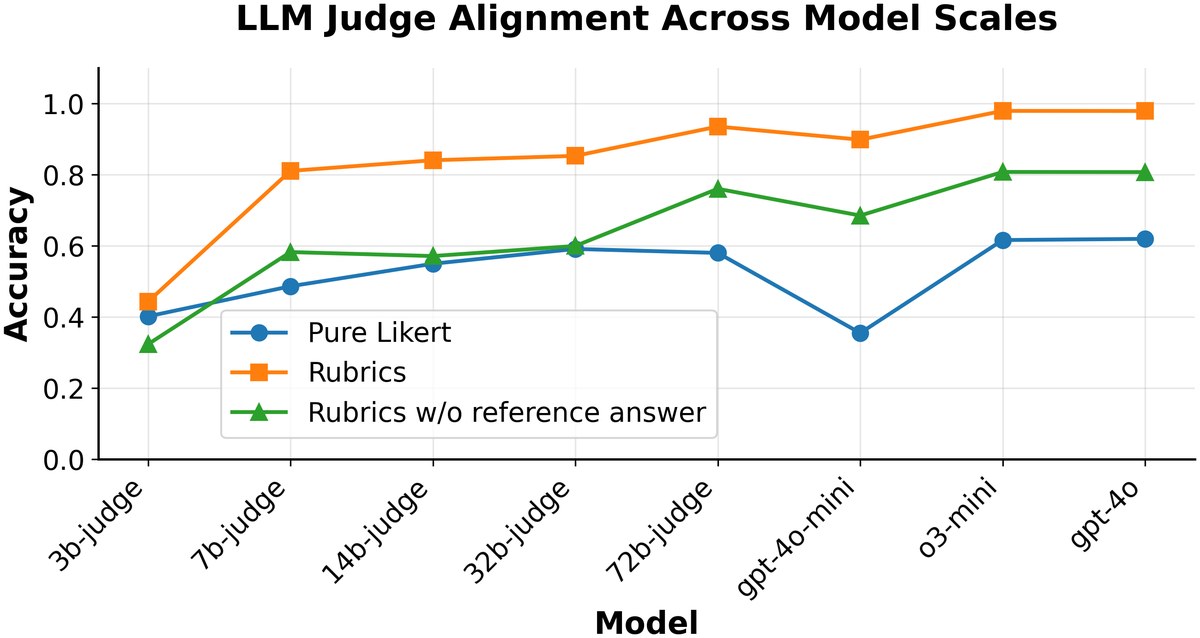
From 2023 to 2024, the industry found an apparently elegant alternative: LLM-as-a-Judge. Stronger models such as GPT-4 and Claude grade other models' answers, usually on a 1 to 10 scale or by picking between two candidate answers in an A/B comparison.
The upside is speed, low cost and scalability. The problems are equally obvious:
Length bias: LLM judges tend to give higher scores to longer answers, even when the extra content is all correct but empty filler.
Format bias: Answers using Markdown lists and bold headings often score higher than plain-text answers.
Self-preference: When GPT-4 judges content generated by GPT-4, the score tends to be inflated; the same holds when Claude judges Claude.
Position bias: In A/B comparisons, the candidate answer shown first is more likely to be chosen.
These biases were repeatedly confirmed in multiple 2024 papers. By 2025, as LLM-as-a-Judge was deployed at scale as a reward signal for reinforcement learning, the harm was amplified - because the model was no longer just being evaluated, it was being trained. The judge's bias becomes the model's evolutionary direction.
2.3 Human Preference and Elo Ratings
Chatbot Arena (LMSYS) takes another approach: hand the judging power to real humans and let them vote with their feet. Two anonymous models answer the same question, a human picks the better one, and an Elo algorithm (similar to chess rating systems) produces the ranking.
This is closest to real user experience, but it has limits: what it reflects is likeability, not professional correctness. A polite, neatly formatted answer with a flawed core judgment often beats a blunt but professionally accurate one in human preference voting.
043. The 2026 Paradigm Shift: Scoring Rules Move from Evaluating to Training
At this point you might think: aren't scoring rules just for evaluation? Run them, publish a leaderboard, and everyone takes a look.
But between 2025 and 2026, the role of scoring rules changed fundamentally. They are no longer just evaluation tools; they have become the reward signal for reinforcement learning (RL) training. How the scoring rule is written determines the direction in which the model evolves.
3.1 RLVR: The Golden Age of Verifiable Rewards
The hottest post-training paradigm of 2025 was RLVR (Reinforcement Learning with Verifiable Rewards). The core logic is simple: find tasks with unambiguous reference answers (math problems, code problems), give 1 point for correct and 0 for wrong, and train the model with this black-and-white signal.
DeepSeek-R1, OpenAI o3 and Qwen3 - this generation of reasoning models - were largely fed by this 0 and 1 reward signal. The effect was striking: performance on math and code benchmarks jumped.
But the limitation is equally clear: this logic only covers tasks with a single correct answer. You cannot use three lines of Python assertions to judge whether an M&A risk memorandum is well written, nor unit tests to verify whether a medical diagnostic analysis is professional.
3.2 When the 0 and 1 Ruler Is No Longer Enough
By the second half of 2026, a consensus was becoming clear across the industry: 90% of the work that is genuinely valuable in the human world is not math fill-in-the-blank questions.
Financial due diligence, legal compliance review, medical image analysis, multi-step tool-calling Agent tasks - these high-value scenarios have no single correct answer, and all the traditional scoring rules break down.
Previously, when facing such open-ended tasks, large labs could only fall back on traditional human preference alignment (RLHF), or ask a large model to give a 1 to 5 overall impression score. The models they trained all turned into yes-men: impeccably formatted, extremely polite, full of correct but empty filler, and hopeless at core business judgment.
This is not because the model is stupid; it is because the scoring rule never told it what good actually means.
3.3 From One Score to A Set of Grading Points
And so, in the second half of 2026, a clear trend emerged: scoring rules are moving from giving one overall score to decomposing into a set of atomic grading points.
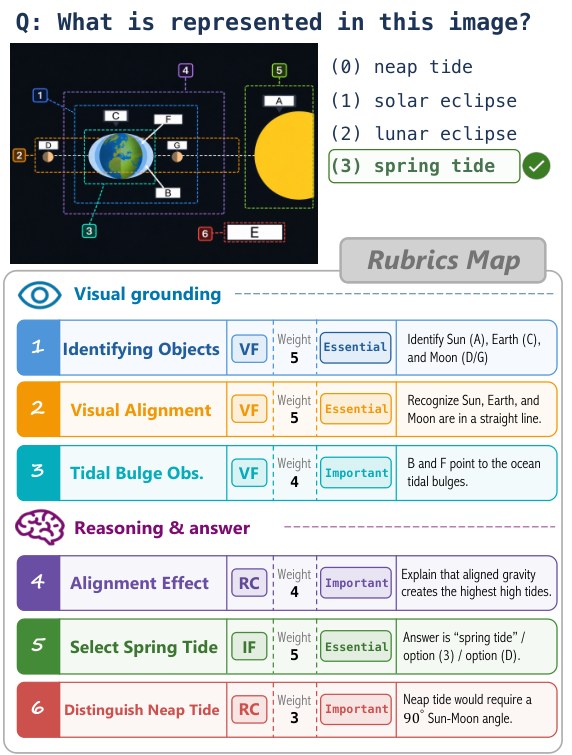
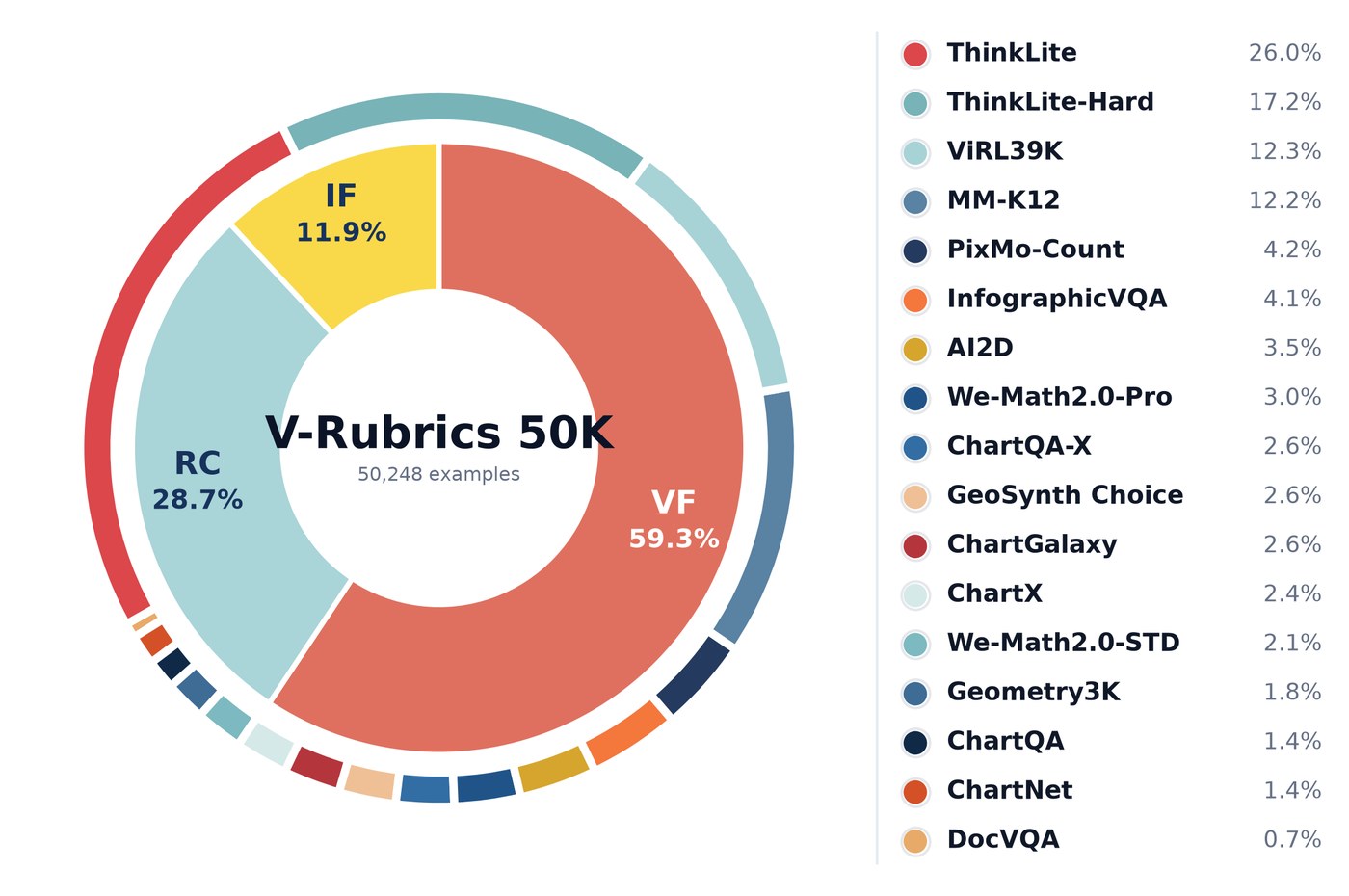
At the end of August this year, Ziwei Liu's team at Nanyang Technological University (S-Lab), together with A*STAR, published V-Rubrics (arXiv:2608.25580, open-sourced as shulin16/v-rubrics). They used Gemini-3-Pro to break the reference answers of 50,000 visual reasoning problems into 352,000 atomic check items. Each criterion checks exactly one thing, and all of them become objective yes/no questions; the items are then weighted by importance and fed into a GRPO reinforcement learning pipeline to train multimodal models.
On October 17, JPMorgan Chase and academic collaborators published Expert-Guided Rubrics as Dense Reward Signals in Non-Verifiable Domains (arXiv:2610.26932), decomposing intent understanding, query rewriting and compliance retrieval in financial services - tasks that previously could not be verified at all - into expert-level scoring rubrics used as dense reward signals.
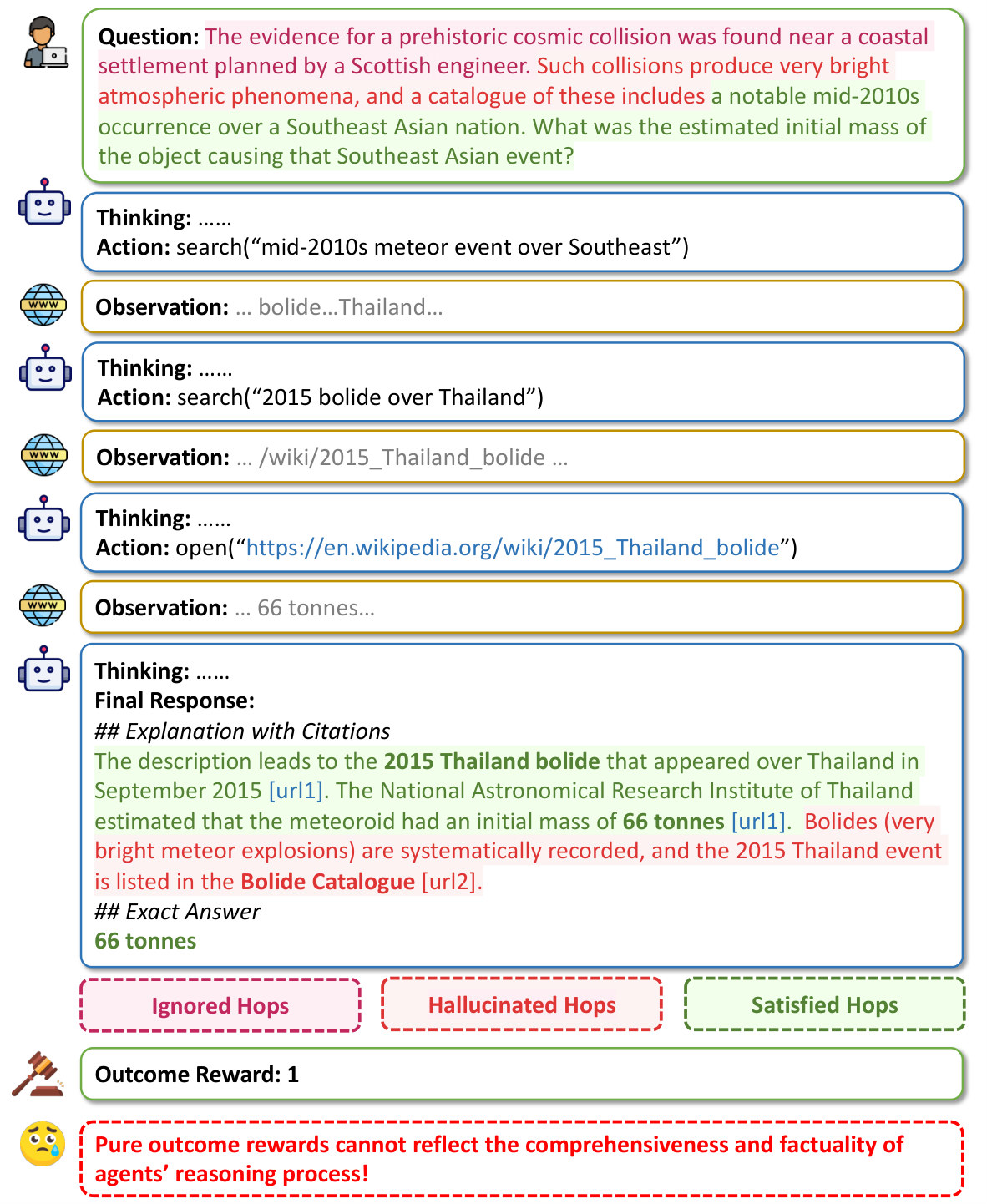
Soon after, the Allen Institute for AI (AI2) open-sourced DR Tulu (rlresearch/dr-tulu), which uses dynamically evolving scoring rules to train Deep Research agents; Tsinghua University and Zhipu also open-sourced CaRR (THUDM/CaRR), which requires deep search Agents to bind every grading point tightly to a chain of real web citation evidence before awarding credit.
What these works share is this: they no longer let a judge assign one vague impression score; instead, they break the standard of good into dozens of independently verifiable atomic assertions. This is more than a simple upgrade to scoring rules - it is a reconstruction of the foundations of the entire post-training paradigm.
054. Hidden Pitfalls in Scoring Rule Design: Lessons from the Field
After all this theory and papers, let's talk about practice.
At DataMining 德塔曼宁, we have spent years providing high-quality task data and executable evaluation environments for large model and agent R&D, serving many of China's leading model companies.
In that work, scoring rule design is where we have stumbled most often and learned the most.
Here are a few typical problems we encounter repeatedly in real projects.
4.1 The 'And' Trap
Many annotation teams unconsciously write rules like: the model needs to answer the user's question accurately and completely.
It looks fine, but it causes serious trouble in actual scoring. If the answer is accurate but incomplete, should the judge award points? If the judge gives half credit, where does that half come from? Different judges will reach completely different conclusions.
Our internal specification now requires that one criterion checks exactly one thing. Conjunctions such as and, while and as well as that bind two things together are strictly forbidden. Accuracy and completeness must be split into two independent check items, each scored separately.
4.2 Bonus Items Only, No Heavy Penalties
Early scoring rule design often contained only bonus items: does it cover all key sub-questions? If yes, +5 points.
But in real business scenarios, some errors cost far more than the gain from getting it right. In a medical scenario, the model offers a plausible-looking but wrongly dosed medication recommendation; in a compliance scenario, the redaction list misses one ID number. If such errors are drowned out by an overall impression score, the consequences can be severe.
That is why we now mandate heavy penalty items (negative grading points) in scoring rule design. For example: failing to redact one patient ID number costs -10 points; omitting a key risk warning costs -7 points. These penalties make the reinforcement learning gradient especially sensitive to such business reefs during training.
4.3 Models Will Game the Rules
This is the most underestimated problem.
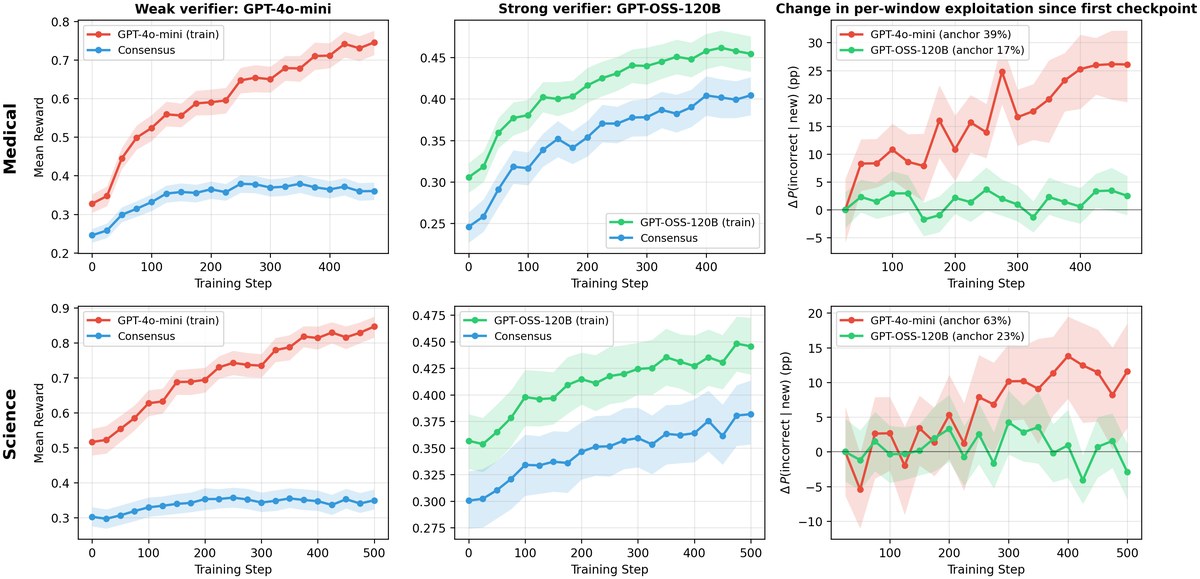
When scoring rules are used in reinforcement learning, the model is not learning, it is optimizing. It will find ways to game the rules (Reward Hacking) that you never imagined.
For example, if a scoring rule contains does the answer contain at least three concrete examples, the model may learn to stuff in three completely irrelevant examples purely to collect points. Or, if a rule requires citations must come from the provided reference material, the model may learn to copy large passages from the source verbatim instead of genuinely understanding and integrating the information.
The way to deal with this is iterative patching: run one round of training or evaluation with the initial scoring rules, analyze the model's outputs to see how it gamed them, then add targeted constraints. This process usually takes several rounds.
4.4 Scoring Rules Must Be Bound to Evidence Chains
Another frequent problem in Deep Research and long-form generation is that judges cannot verify the factuality of a model's answer.
Say the model writes an industry analysis report citing three data sources. If the judge (human or LLM) has no original material to check against, it can only rely on its own knowledge, and misjudgments come easily.
So the current trend is: every factual grading point must be bound to a verifiable evidence chain. The model must not only give the conclusion but also mark which document, which paragraph and which specific data point it came from. CaRR from Tsinghua and Zhipu is a solid exploration in this direction.
065. Scoring Rules Are Reshaping the Entire Data Supply Chain
One last, broader observation.
As scoring rules move from evaluating to training and from one score to a set of atomic grading points, their impact has reached far beyond evaluation itself. They are reshaping the underlying logic of the entire large-model data supply chain.
Previously, data vendors delivered questions plus reference answers. The client would run an Exact Match or Pass@k, and the score came out.
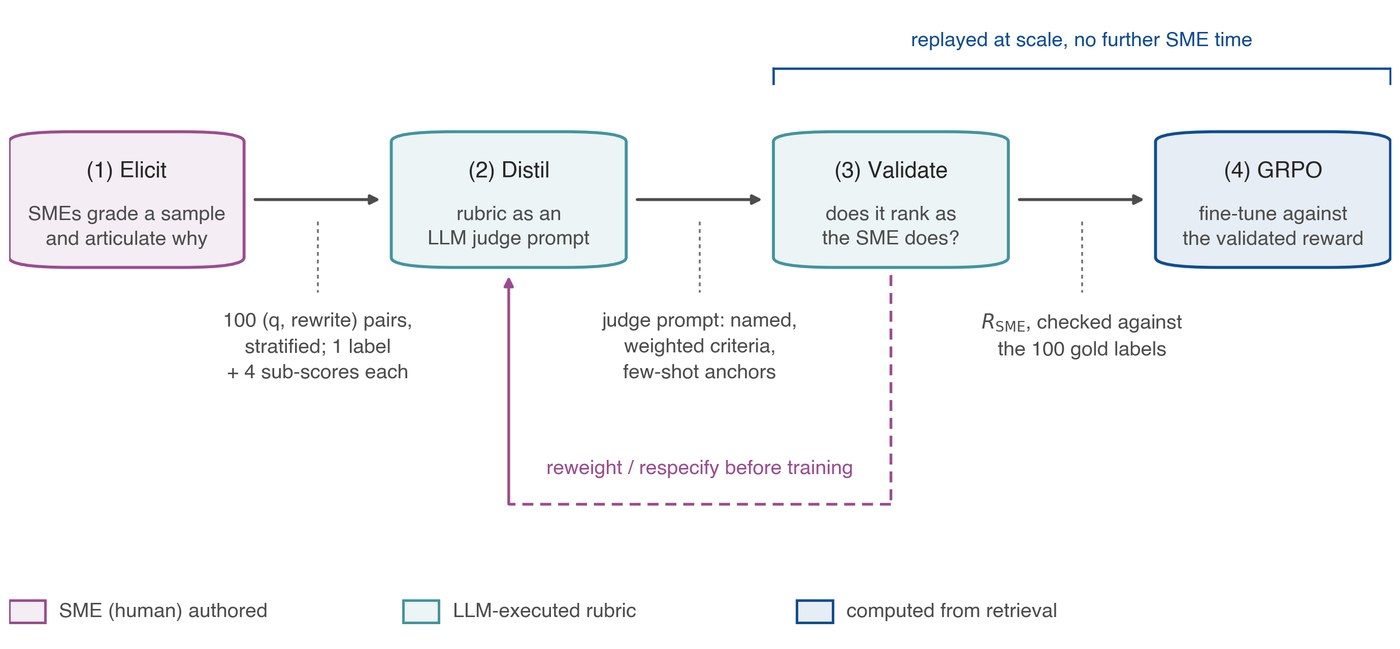
Now, what the client wants is not a reference answer but a rule system that can grade stably. The question they ask is: can you translate the tacit experience of a partner reviewing a case, an auditor detecting fraud, or a doctor reading a scan into 35 to 60 atomic rules that a machine can grade consistently?
In mid-October this year, a leading Chinese model company and a data hub updated version 2.0 of their professional industry Agent procurement specification. It states a hard threshold in black and white: every long-horizon task in finance, taxation, legal or medical domains must be accompanied by no fewer than 35 atomic positive and negative Rubrics. The rules are exacting: one criterion checks exactly one thing, it must state explicitly which deliverable file it checks, and it must include heavy penalties for business-critical errors.
This means that whoever can translate the tacit judgment standards of industry experts into machine-executable scoring rules holds the core resource of the second half of post-training.
076. Summary: Scores Are Products of Rules, and Rules Decide the Direction of Evolution
To recap the core logic of this lecture:
Scores do not exist naturally. The same model answer, measured with different scoring rules, produces completely different scores.
Scoring rules have evolved from a hard ruler to a soft ruler and then to atomic grading points. Exact Match → Pass@k → BLEU/ROUGE → LLM-as-a-Judge → Rubric-based multi-dimensional scoring.
In 2026, the role of scoring rules changed fundamentally: they are no longer just evaluation tools but have become the reward signal for reinforcement learning. How the rule is written determines the direction in which the model evolves.
Traditional scoring rules are no longer adequate for open-ended tasks. When a 0 and 1 ruler cannot measure the quality of a due diligence report or a medical analysis, we need finer instruments.
Which brings us to the central question of the next lecture: for open-ended tasks with no reference answer, how exactly should we design this set of atomic grading points? What is its structure, how is it built, and how do we stop models from gaming it?
That is the problem Rubric (detailed scoring rubrics) is meant to solve.
About DataMining 德塔曼宁 We are a team of PhD students from the Software Institute, School of Computer Science, Peking University. We have long provided high-quality original task data and executable evaluation environments for large model and agent R&D, serving many of China's leading model companies. Scoring rule design, atomic Rubrics and anti-gaming graders are where we have stumbled most and accumulated the most. Benchmarks we can deliver: code engineering (Deep SWE / Frontier SWE), real-environment long-horizon operation (ALE / Terminal-Bench), extreme mathematics and science, Rubrics and anti-gaming graders for open-ended tasks, plus task data and private blind test sets for embodied intelligence and cyber.
Further Reading
All figures in this article are taken from the original figures of the papers below, without redrawing.
- V-Rubrics: Visual Faithfulness via Rubric-Based Reinforcement Learning. arXiv:2608.25580, 2026.
- Expert-Guided Rubrics as Dense Reward Signals in Non-Verifiable Domains. arXiv:2610.26932, 2026.
- DR Tulu: Reinforcement Learning with Evolving Rubrics for Deep Research. arXiv:2511.19399, 2025.
- Chaining the Evidence: Robust Reinforcement Learning for Deep Search Agents with Citation-Aware Rubric Rewards. arXiv:2601.06021, 2026.
- Rubrics as Rewards: Reinforcement Learning Beyond Verifiable Domains. arXiv:2507.17746, 2025.
- Reward Hacking in Rubric-Based Reinforcement Learning. arXiv:2605.12474, 2026.
- Judging LLM-as-a-Judge with MT-Bench and Chatbot Arena. ICML 2024.
- SWE-bench: Can Language Models Resolve Real-World GitHub Issues? ICLR 2024.